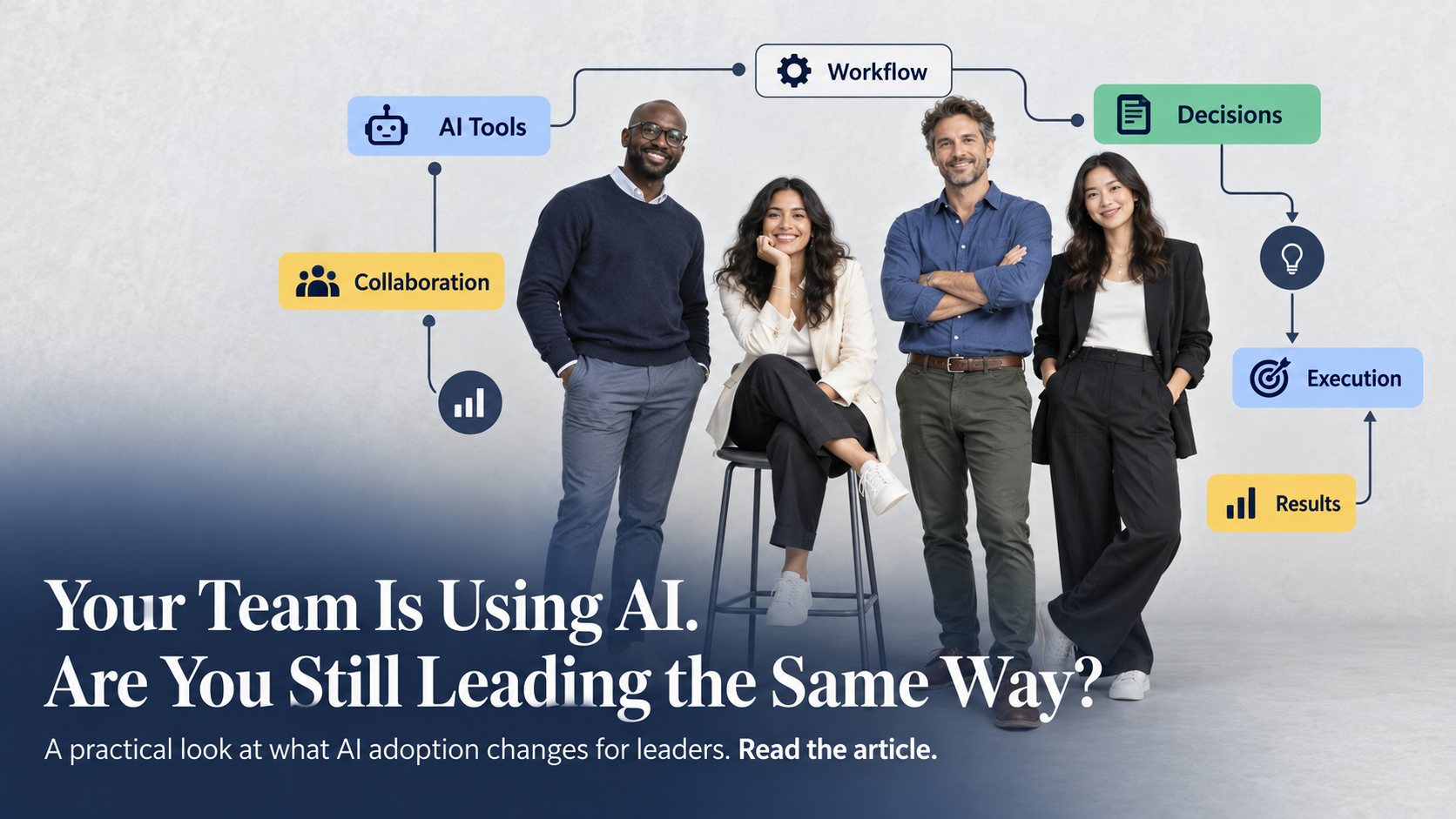
I think the risk is asking people to work differently while leaving their responsibilities, and our own role, largely unchanged. Faster work then becomes the achievement, rather than a starting point for running the business better.
When I started introducing generative AI into the oncology franchise at Merck KGaA in 2023, our first priority was to give people access and room to experiment. We secured early access to ChatGPT and decided, as a management team, to let people build applications from the ground up. We wanted the team to help discover where AI could be useful, rather than expect management to have all the answers.
That experience shapes how I think about AI leadership today. Building AI literacy, turning it into useful applications and changing the operating model require different leadership choices. The freedom to experiment remains important, but it needs to be accompanied by clearer decisions about what deserves investment, where people’s time should go and how much responsibility they can take. The challenge for the leader is knowing how to make that shift while helping the team grow with it.
Building AI literacy and giving people room to experiment
Early on, I treated access as an investment in the team’s capabilities. Before people could identify where AI would create value, they needed to understand what it could do and where it fell short. Expecting a fully developed business case before they had that opportunity would have put the financial question ahead of the learning needed to answer it.
Our approach also reflected a choice about where ideas should come from. I wanted people close to the work to have room to identify opportunities, rather than expect the management team to prescribe every application. We could establish a direction while allowing people to explore how the technology might help with the problems they understood best.
For me, that remains an important leadership responsibility in the early stages: creating enough confidence and permission for people to participate, including those who would not normally see themselves as technology experts.
Making AI useful in daily work
When my team and I developed AI applications, we started with problems we actually had. Some of what we built was relatively simple, but people used it because it helped them do their work. That mattered more to me than the sophistication of the technology or how impressive an application looked in a demonstration.
There is evidence for the productivity opportunity. In a 2023 experiment involving 758 BCG consultants, people using AI completed tasks within the model’s capabilities more than 25% faster, with better-rated results. The gains were not uniform across tasks, which is why understanding the work remains essential. 1
At this stage, I think leadership needs to connect individual experimentation to shared business priorities. An application that helps one person may deserve wider use. Several teams solving the same problem separately may need a common approach. The judgment is in recognising what is worth developing further without removing the initiative that produced it.
Changing the operating model
Once useful applications are established, the discussion needs to move beyond productivity. Faster access to analysis should lead us to reconsider how much effort goes into producing information, who needs to interpret it and where people’s capacity could make a greater contribution.
In a global business, that could mean building a shared analytical capability rather than repeating the same work across markets. It could mean moving capacity from routine reporting into understanding customers, addressing access barriers or evaluating growth opportunities. Some existing work may no longer justify the same resources. Other work that was previously too expensive or time-consuming may become possible.
These are choices about the business, and they require more than adding AI to existing job descriptions. A team that prepares analysis faster but still waits through the same layers of approval has improved one activity without necessarily improving the decision. Equally, time saved does not automatically become a financial saving or additional growth. Leadership has to decide what changes and where that capacity goes.
This is where I think the next stage becomes more demanding. It requires leaders to reconsider responsibilities and investment, while helping people understand how their contribution can grow as parts of their work change.
Choosing which AI projects deserve investment
As we moved from learning toward scale, AI became a budget line that I had to justify. The question became what the business was getting back for the resources committed.
For larger investments, I want a business case that identifies the problem, the deliverable and the measurable outcome, with a business owner responsible for achieving it. Building an AI assistant is a deliverable. Improving customer coverage or reducing the cost of a recurring process is the business outcome. The case also needs to account for implementation and ongoing support, rather than treating the software price as the full investment.
Projects should compete with other uses of the same resources, including simpler solutions that do not require AI. I favour committing funding in stages, with the evidence needed for further investment agreed in advance. A small experiment can be funded to answer a worthwhile question. A wider rollout needs stronger evidence that people will use it, that it performs reliably and that the expected benefit justifies the cost.
That leaves room for innovation without giving every project carrying an AI label a claim on the budget.
What this changes in the people we ask to lead
The decision to give people broad access also changes what we should expect from their managers. When team members can obtain analysis and develop options themselves, the manager’s contribution needs to extend beyond reviewing their output. I put more weight on the ability to define the problem, judge the evidence and give people appropriate authority to act.
Managers need to understand the business and AI well enough to judge a recommendation. I want a manager who can explain what the analysis is missing when they disagree, but is also willing to change their mind when the team has a stronger case. Accepting a recommendation because “AI said so” is not enough either. They need to understand why it makes sense for the business.
Independent thinking matters too. Research published in Nature Human Behaviour found that AI can improve individual ideas while making the overall set of ideas less diverse. 2 My takeaway is practical: don’t ask AI to create the common view before people have formed their own. On important decisions, let different functions develop their position first, then use AI to challenge and test those views rather than make everyone converge too early.
For a leadership team, the practical implication is to preserve different views before bringing them together. People should contribute their understanding of the business and be willing to challenge the preferred answer. AI can help test those arguments. The discussion then has a better chance of resolving a real trade-off, rather than approving a polished summary.
These are also qualities I would give more weight to when developing and selecting managers: sound judgment, the confidence to delegate and the ability to help others take responsibility. People need opportunities to exercise those qualities as their work changes, not simply more training on the tools.
I still believe in giving teams room to build from the ground up. What needs to grow alongside that freedom is the discipline to choose which ideas deserve investment, and the willingness to change how the business operates when those ideas work. That is how I see the leadership task evolving beyond AI adoption.
Sources
- Harvard Business School, Digital Data Design Institute. Navigating the Jagged Technological Frontier. Research summary of the field experiment conducted with Boston Consulting Group. 21 September 2023. ↩
- Meincke, L., Nave, G. and Terwiesch, C. ChatGPT decreases idea diversity in brainstorming. Nature Human Behaviour, 9, 1107–1109. 14 May 2025. ↩
Newsletter · from Accumulating Impact
Impact Notes.
A monthly letter. One piece, no noise.
Each month, we write one piece on building, buying and rescuing life sciences businesses: what moved in the market, the decision behind a deal, and what it changed. It is the same thinking published on this site, sent to your inbox first.
Almost there. Check your inbox and confirm your address.
A short welcome note arrives once you confirm. After that, one letter at the end of each month, and nothing in between.
Read the last one →That address doesn't look complete. Check it and try again.
Something failed on our side, not yours. Try again, or write to info@accumulatingimpact.com.
One email a month. Unsubscribe in one click.