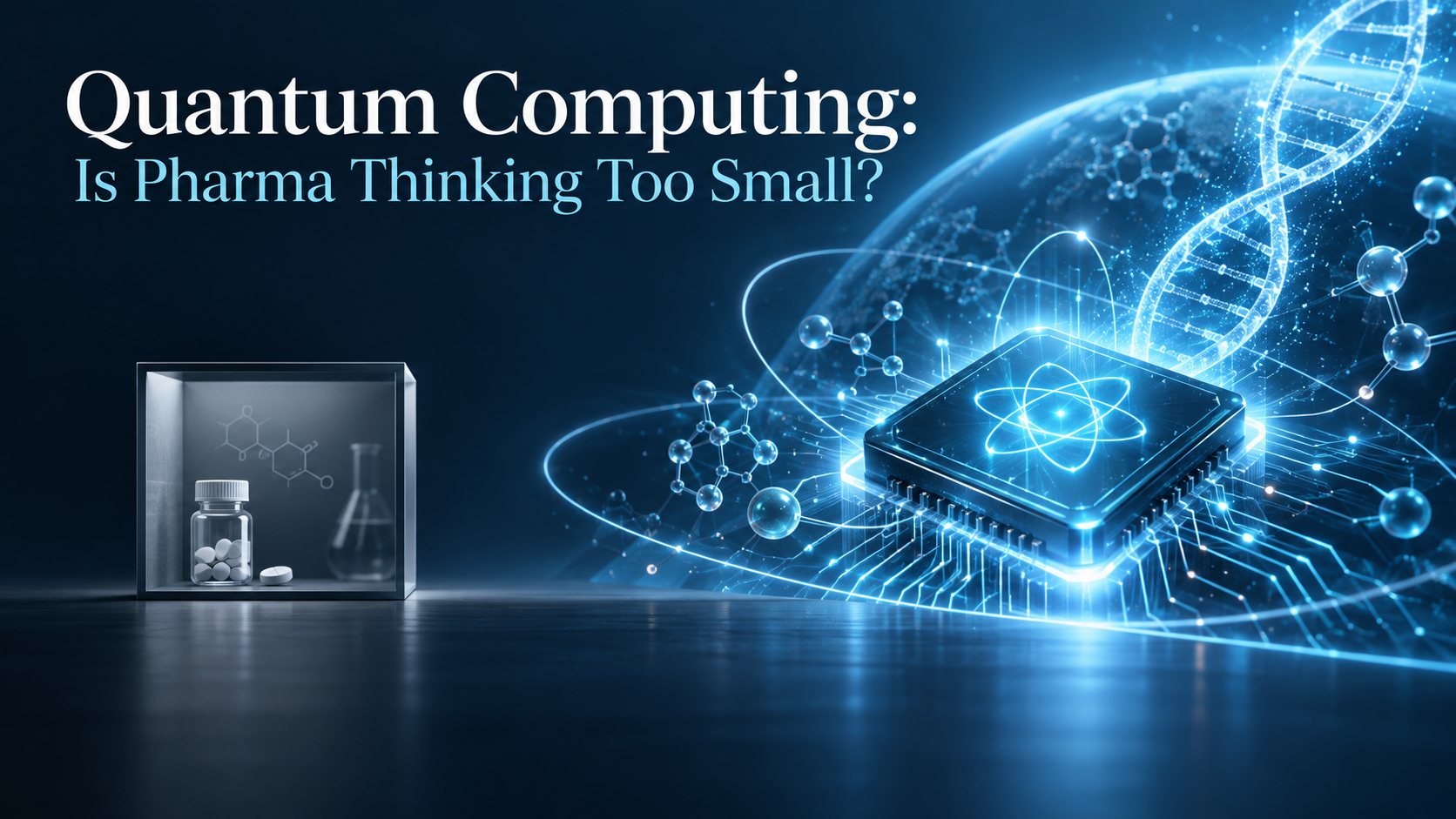
That is the commercial question I would bring to AI and quantum computing. The most interesting possibility is that quantum computing, AI and the scientific knowledge inside pharma become more useful when they work together. Recent research is beginning to show how that could happen. For me, that deserves attention well beyond the teams responsible for technology. 2
The commercial opportunity is broader than saving time
Having led a global oncology business and worked in business development and partnering, I look at these advances through the medicines and portfolios they could help us build. From a commercial perspective, I see three potential sources of value.
The first is more credible shots on goal. AI and quantum could expand the range of promising candidates we can pursue, including molecular designs that remain difficult to explore with today’s tools. I would want that to translate into more worthwhile development opportunities, rather than simply more computer-generated molecules.
The second, and the one I would give particular attention to, is a higher probability of success for the compounds we take forward. Better modeling could help us improve a molecule’s design or select a stronger candidate before committing to development. Recognising a weakness earlier only creates value if we act on it. We might resolve a stability problem, choose a more suitable design or decide not to advance an unsuitable compound. Producing more candidates is useful, but improving their chances of becoming medicines could make a much greater difference to the portfolio.
The third is shorter timelines and lower costs. If better modeling helps a team avoid unnecessary rounds of laboratory work, or recognise earlier that a design needs to change, there could be a meaningful productivity benefit. I would be careful about translating that into a claim that the whole medicine will become cheaper to develop. But I would take seriously the possibility of using the same scientific resources to explore better alternatives.
Understanding molecules better
We already use computers to study molecules before making and testing them in the laboratory. The difficulty is that an accurate description requires understanding how atoms and electrons interact. For some problems, the calculations become too demanding, even for powerful computers, so scientists have to simplify them. Quantum computers approach these calculations differently, using the physical behaviour of particles at the atomic scale. This offers a possible way to model certain molecular interactions with fewer compromises. 1
Those details can have practical consequences. Understanding how a molecule reacts, or why it breaks down, is part of determining whether it can become a usable medicine. A compound can be interesting from a treatment perspective and still present difficult problems in its chemical development. The researchers working on quantum chemistry are trying to improve our ability to understand some of those problems. 2
Why AI and quantum belong in the same discussion
Pfizer’s work with Quantinuum and NVIDIA provides a concrete example. In research described in August 2026, the team used AI to generate instructions for quantum chemistry calculations and tested selected instructions on an actual quantum computer. Their test case was imipramine, an existing antidepressant, chosen for chemistry relevant to understanding how medicines degrade. 1, 2
That may sound less exciting than discovering a new treatment, but I would not dismiss its importance. A medicine must be made and stored reliably before it can help anyone. Better understanding of those chemical problems could have value across development, even when the immediate result is not a new drug candidate.
The researchers reported a faster way to prepare the instructions for certain calculations. The improvement concerned that step, not an entire drug-development programme. It also showed a specific role for AI: helping make quantum computing more usable while conventional computers continued to do much of the work. 2
A study published in July 2026 in Scientific Reports explored the relationship from another direction. Researchers from Japan Tobacco and D-Wave integrated a D-Wave quantum system into an AI model that proposed molecular designs. Compared with the fully conventional versions tested, their combined approach produced designs with better scores for chemical validity and properties associated with potential medicines. 3
For pharma, I would assess AI and quantum together against the development problems we need to solve. The opportunity is to combine their strengths to produce better molecular designs and help promising compounds progress. These studies provide early evidence for that approach. Whether it translates into a higher probability of clinical success remains to be demonstrated.
Capital is moving, and pharma has a role in directing the work
McKinsey reported in June 2026 that investment in quantum technology start-ups reached $12.6 billion in 2025, 6.3 times the previous year’s level. That covers the wider quantum sector, not specifically pharma. The resources going into the field are substantial, although funding alone cannot establish scientific value. 4
There is also continuing work on the machines themselves. In August 2026, IBM reported an engineering advance toward its planned error-corrected quantum computer for 2029. That is a manufacturer’s development target, not a date when pharmaceutical applications can be assumed to be ready. It does, however, put the ambition within a period that matters for long-term research and partnering decisions. 5
I think the quality of those partnerships will matter at least as much as access to the machines. The Pfizer example brings together a pharmaceutical problem, expertise in AI and computing, and quantum hardware and software. Each contribution has a purpose in the research.
Pharma needs to bring the problems that are holding promising medicines back. Our scientists should work directly with AI and quantum specialists, then test the proposed solutions in the laboratory. Business leaders need to connect that work to the treatments patients need and the portfolio the company wants to build.
Pharma business leaders should make this part of the portfolio discussion now, alongside their R&D teams. Where could AI and quantum help us pursue a medicine we cannot develop well enough today? The ambition should be to change the standard of care, particularly in diseases where progress remains limited, and, where possible, move closer to cures. I think that is an opportunity we should actively help shape.
Sources
- Quantinuum. Teaching AI with Quantum Data. 18 August 2026. ↩ ↩
- Quantinuum, NVIDIA and Pfizer. Learning to Prepare Molecular Ground States with Transformer Models. arXiv:2607.22468. 24 July 2026. ↩ ↩ ↩ ↩
- Scientific Reports. Molecular design beyond training data with novel extended objective functionals of generative AI models driven by quantum annealing computer. 9 July 2026. ↩
- McKinsey & Company. Quantum investment surge. 24 June 2026. ↩
- IBM. IBM connects its first modular cryogenic systems. 19 August 2026. ↩
Newsletter · from Accumulating Impact
Impact Notes.
A monthly letter. One piece, no noise.
Each month, we write one piece on building, buying and rescuing life sciences businesses: what moved in the market, the decision behind a deal, and what it changed. It is the same thinking published on this site, sent to your inbox first.
Almost there. Check your inbox and confirm your address.
A short welcome note arrives once you confirm. After that, one letter at the end of each month, and nothing in between.
Read the last one →That address doesn't look complete. Check it and try again.
Something failed on our side, not yours. Try again, or write to info@accumulatingimpact.com.
One email a month. Unsubscribe in one click.